How to Convert JPG to PDF Without Losing Quality
A sharp PDF starts with a sharp JPG. The best settings preserve the full image, avoid unnecessary margins and do not enlarge a low-resolution source.
Quick answer
What you need to know first
A sharp PDF starts with a sharp JPG. The best settings preserve the full image, avoid unnecessary margins and do not enlarge a low-resolution source.
- 1Use the original JPG instead of a compressed copy.
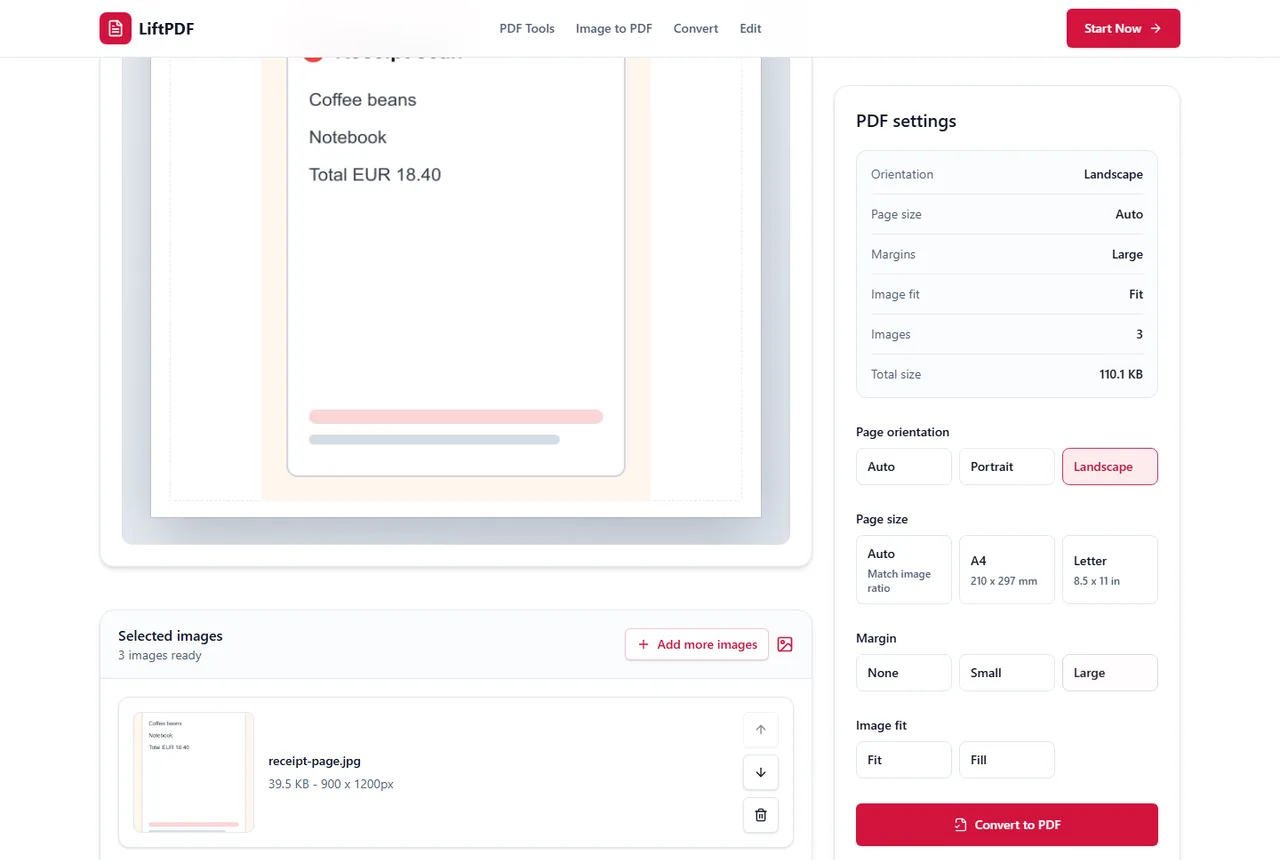
- 2Choose Auto page size when the PDF should match the image ratio.
- 3Use Fit to keep the full image visible.
- 4Avoid large margins unless you need print whitespace.
How to keep the PDF looking sharp
The final PDF can only be as sharp as the source JPG. Start with the highest-resolution original image you have, avoid screenshots of screenshots, and do not repeatedly resave the same JPG before converting.
Use Auto page size with no margin when you want the PDF page to follow the image ratio. Use A4 or Letter when a school, office or upload portal requires a standard document page.
- Fit keeps the full image visible.
- Fill covers the page but can crop edges.
- Large margins are useful for printing notes, not for maximum image size.
What conversion can and cannot improve
A converter cannot add detail that is not in the source image. If the JPG is small, heavily compressed or already blurry, the PDF will show the same limits.
What LiftPDF can do is avoid unnecessary layout damage. Auto page size, no margin and Fit mode are usually the safest settings for preserving the original look.
Page size, orientation and margins
JPG images do not have a fixed paper size. The PDF layout is created during conversion, so page size and margin choices matter. Auto keeps the document close to the image shape, while A4 and Letter create standard paper pages.
Portrait and landscape should match the way the image is meant to be read. If you are unsure, Auto is the simplest starting point.
Privacy and browser processing
LiftPDF creates the PDF in your browser for supported JPG files. The conversion does not need a document upload API, which is useful when photos include IDs, receipts, contracts, class notes or personal records.
This does not replace careful file handling, but it removes a common risk in online converters: sending private images to a remote conversion queue for a simple PDF task.
FAQ
Questions about JPG to PDF
Can I convert JPG to PDF for free?
Yes. LiftPDF lets you convert JPG and JPEG images into a PDF for free in your browser.
Can I convert multiple JPG files into one PDF?
Yes. Add multiple JPG images, arrange them in the right order and export one PDF with each image on its own page.
Will converting JPG to PDF reduce quality?
LiftPDF places the original image into a PDF page. Quality mainly depends on the source image resolution and the layout choices you make.
Are my JPG files uploaded?
For supported files, the PDF is generated locally in your browser. Your images do not need to be uploaded to a server for conversion.
Why does my PDF look blurry after converting?
The source JPG may be low resolution, heavily compressed or enlarged too much on the PDF page.
Is Fill better quality than Fit?
No. Fill covers the page and can crop edges. Fit is safer when preserving the full image matters.
Editorial note
LiftPDF Editorial Team
LiftPDF articles are written against the behavior of the public LiftPDF tools. We avoid fake expert bylines, invented claims and workflows that the product cannot actually perform.
Published Jul 15, 2026. Last updated Jul 16, 2026.